
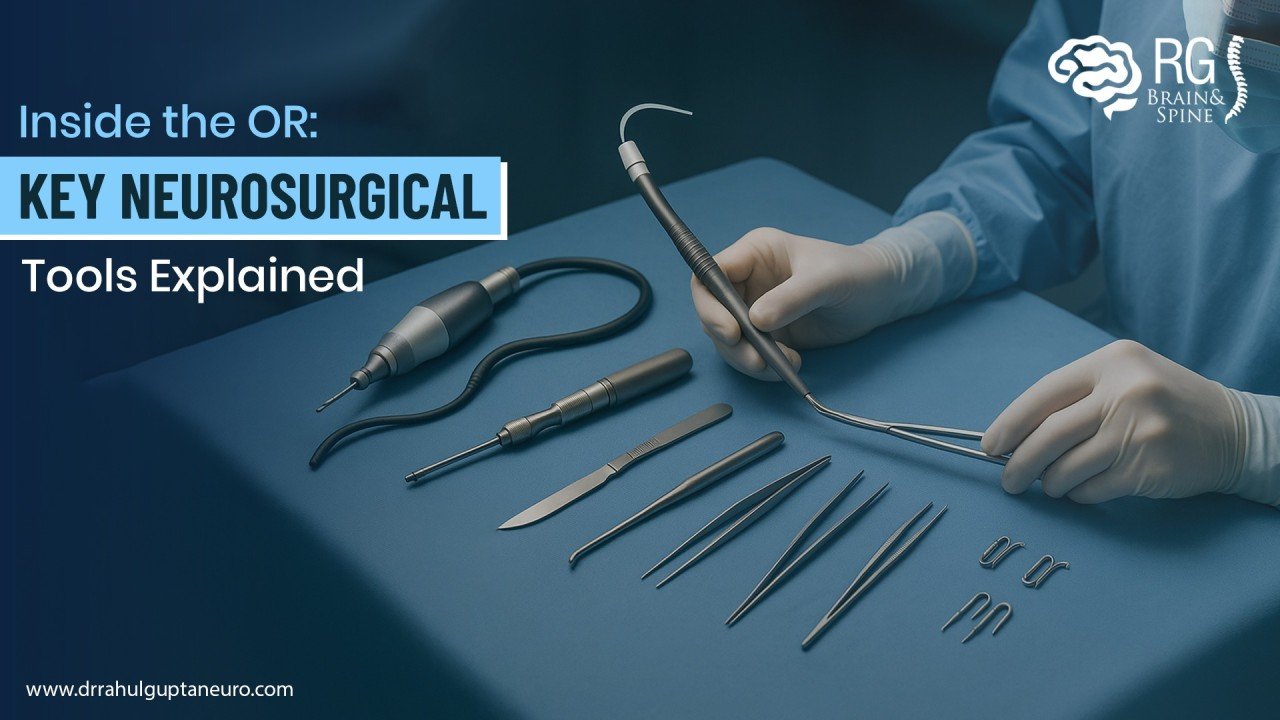
Explore the most essential neurosurgical instruments—from retractors and microscopes to neuro navigation systems and robotic tools—that optimize precision, protect patient outcomes, and streamline brain and spine surgery.
- Brain Retractors & Self-Retaining Retractors 🧠
These tools hold back delicate brain tissue to create a safe window for the surgeon. They help protect critical brain structures like the motor cortex and speech centers, minimizing pressure, trauma, and post-op complications such as swelling - Microsurgical Instruments: Micro‑forceps & Micro‑scissors
Designed for ultra-precision, these instruments have extremely fine tips that allow surgeons to manipulate tiny vessels and neural tissue—vital during aneurysm clipping, tumor removal, or microvascular repair. Their accuracy significantly reduces collateral tissue damage and improves recovery outcomes - High-Speed Cranial Drills & Perforators
Used to create burr holes and craniotomy windows, these drills feature built-in guards to preserve the underlying dura. By enabling safer skull access, they facilitate controlled operations with fewer risks - Electrocautery & Bipolar Forceps
These tools provide precise coagulation and hemostasis—an essential function to prevent bleeding and hematoma formation during surgery. By maintaining a stable surgical field, they help reduce blood loss and improve postoperative neurological stability 5. Neurosurgical Operating Microscopes & SurgiScope
High-powered surgical microscopes (including robot-mounted versions like SurgiScope) offer magnified, illuminated views of the surgical field—essential for micro-neurosurgery. They enhance visualization of blood vessels and tumor margins, significantly improving precision
- Neuro navigation & Stereotactic Systems
These tools integrate real-time imaging (CT/MRI) with surgical instruments to guide the surgeon precisely to the target—critical for leaning around important structures like speech or memory regions. Their use improves accuracy and functional preservation 7. Neuro-Endoscopes & Robotic Systems
Miniaturized cameras—neuro-endoscopes—enable minimally invasive access through small openings, offering visual clarity and faster recovery. Robotic systems like NeuroArm further enhance dexterity, allowing precise movements in confined areas—ideal for tumors and deep-seated lesions
- Spinal Retractors, Disc Curettes & Bone Rongeurs
In spinal surgery, tools like Scoville retractors, curettes, rongeurs, and Caspar distractors enable tissue retraction, bone removal, and vertebral alignment. These support safe decompression and spinal fusion procedures - Drills, Driving Guides & Screwdrivers (Spine Instrumentation)
Precision-guided drills and screwdrivers are used to place spinal implants and hardware. Drill guides such as the Caspar system ensure accurate screw trajectory, improving spinal stabilization results - Advanced Simulation & AI Tools
Tools like dextroscope VR systems and AI-enabled surgical drill prototypes allow surgeons to rehearse cases and receive real-time feedback. Integrating 3D virtual models refines surgical plans and reduces operative errors
✅ Why These Tools Matter
🛡️ Safety & Precision – Minimizing tissue trauma and blood loss
🚀 Better Outcomes – Fewer complications and faster recovery
🧠 Functional Preservation – Protecting cognitive, motor, and neurological functions
📊 Technological Edge – Robotics and AI enable smarter interventions
🔚 Conclusion
Neurosurgery demands extreme precision—each instrument, from retractors and microscopes to neuro navigation systems, plays a vital role in safeguarding patient health. By combining traditional tools with cutting-edge robotics and simulation, modern ORs empower neurosurgeons to perform safer, more effective brain and spine procedures.